Three Great Bodhisattvas of Mahayana Buddhism
Category: Buddhist Path | Mind Trainer Articles | Popular | Recent Meditation Posts
Channeling the qualities of wisdom, compassion, and power
Three great bodhisattvas hold a central place in traditional Mahayana Buddhist writings and practices: Manjushri, Avalokiteshvara, and Vajrapani. Who are they? What do they represent? How should we relate to them? And how can they inspire our practice?
As we know, there are different levels of bodhisattvas. There are aspiring bodhisattvas, like ourselves, who are learning about the Mahayana path and developing the ability to benefit others. And there are realized bodhisattvas, great practitioners who have accomplished these practices to a very high level and have a phenomenal depth of realization. Among the latter, three are particularly prominent in the Buddhist canon and are great sources of inspiration.
Manjushri, the embodiment of wisdom
The first great bodhisattva is Manjushri, the embodiment of wisdom. Wisdom holds a very special place in the Buddhist teachings. People may think that Buddhism’s main focus is developing compassion and helping others, and of course these are essential qualities. But the desire to help others is not limited to the Buddhist traditions—it is emphasized in a good many other spiritual paths as well. The Buddha’s unique gift to us is his teaching on wisdom. Here, wisdom means understanding selflessness, understanding emptiness, understanding the nature of mind; with such understanding our compassion becomes vast and unlimited. Genuine bodhicitta is comprised of both wisdom and compassion.
Manjushri is the bodhisattva who embodies the wisdom teaching of the Buddha. He’s often referred to as “the Youthful One.” Youthful here underscores the idea of timeless wisdom, wisdom that is beyond age in that it is new and fresh in every moment. In many Buddhist sutras and Mahayana teachings, Manjushri is found explaining the various aspects of wisdom.
Iconographically, Manjushri is usually characterized as holding a double-edged sword aloft in his right hand. The sword need not strike; just by being wielded, the edges cut through the dual obstacles of self and other. The sword cuts through duality without even moving; just brandishing it is sufficient. Manjushri usually holds a lotus in his left hand, and upon the petals of the lotus is a book or text, typically the Prajnaparamita, the Perfection of Wisdom teachings of the Buddha. He may be depicted riding a lion, conveying confidence or fearlessness.
Avalokiteshvara, the embodiment of compassion
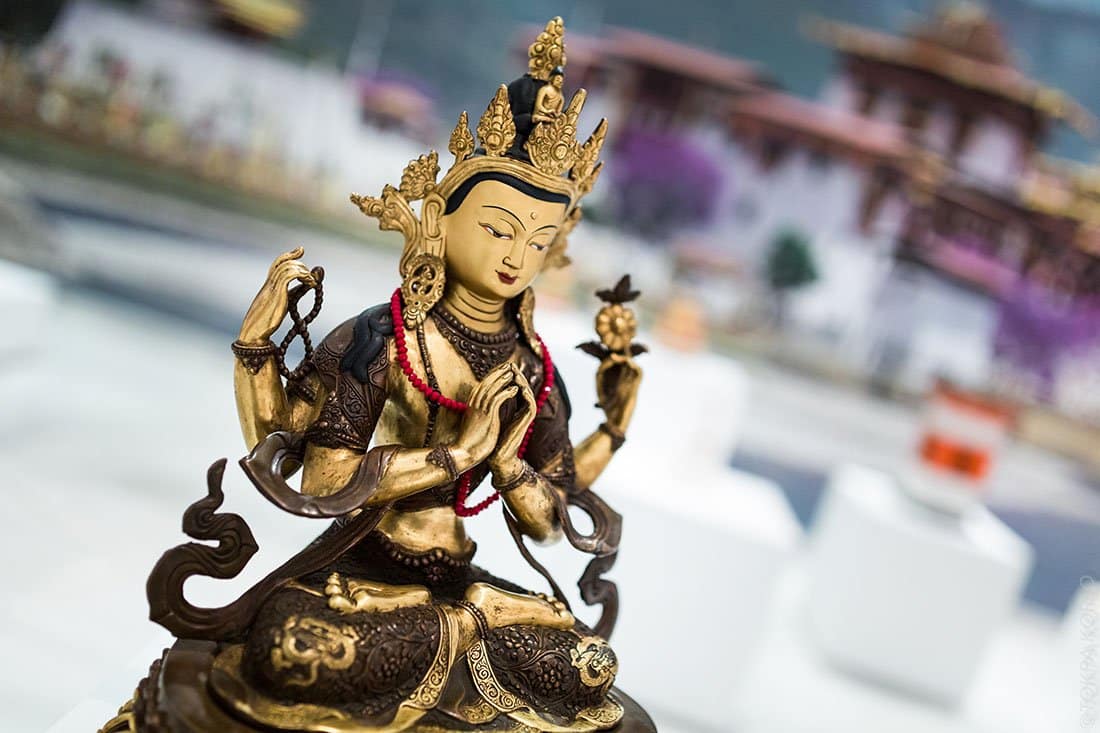
The second great bodhisattva is Avalokiteshvara. Avalokiteshvara is a Sanskrit name that means Lord who gazes down upon the world. His Tibetan name, Chenrezig, is equally evocative: it means He who beholds with eyes of compassion. Avalokiteshvara’s compassion is understood to be completely unlimited. This bodhisattva takes many forms, corresponding with the countless methods he uses to help beings. In the Buddhist traditions of the Far East, Avalokiteshvara can be represented as female, male, or androgynous. In China she is known as Guanyin, The One who hears the sounds of the world. Avalokiteshvara’s mantra, Om Mani Padme Hum, is printed on prayer flags, carved in stone, placed in prayer wheels, and recited and chanted by Vajrayana practitioners throughout the world.
One very prevalent form of Avalokiteshvara in the Tibetan canon is Four-Armed Chenrezig. Two hands are held together in the prayer mudra, symbolizing aspirations to benefit beings. In his other right hand he holds a crystal rosary, and in the left the stem of a lotus flower.
The iconography of Avalokiteshvara is rich with meaning. Symbolically speaking, if our intention is to benefit beings, the more hands we have, the greater our ability to help. In some manifestations, Avalokiteshvara has a thousand arms and eleven heads because when compassion is limitless, there are limitless ways to be of benefit.
Avalokiteshvara’s compassion manifests as his aspiration to become whatever is necessary to assist sentient beings—he might manifest as a boat or a bridge, or he might descend into the hell realms to care for its inhabitants. It is said that his compassion is so vast that he would readily spend eons in the hell realms just to save one single sentient being. He is unaffected by the terrible experience of suffering in such realms because he has no self-cherishing. For him and the other highly realized bodhisattvas, this kind of activity is not difficult—it’s a joy. Their sole purpose is to work with and benefit others, and they can go through what to us would be tremendous suffering and hardship without any hesitation because there’s no attachment to self. No self, no problem.
Vajrapani, the embodiment of power
The third main bodhisattva is called Vajrapani, and he is the essence of power. You may think: that’s interesting—what is the purpose of power? Well, if bodhisattvas are wise and compassionate but have no power, their reach is limited and they can’t help very many beings. Power is necessary to benefit others on a vast scale.
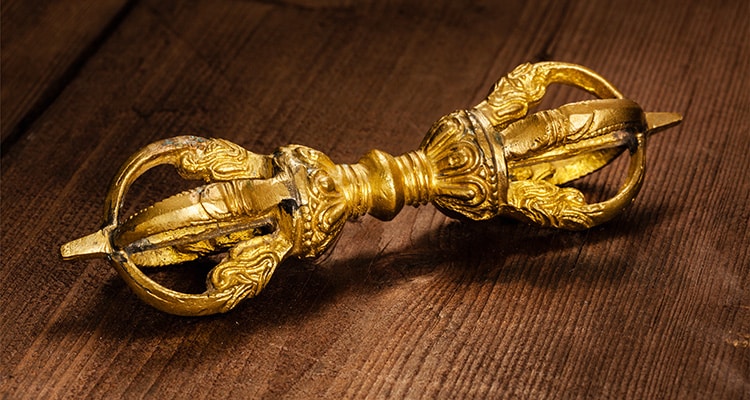
Vajrapani channels this kind of energy. In Sanskrit, his name means “Holder of the Thunderbolt.” Vajrapani’s iconography is dominated by his fierce, powerful appearance and the vajra (thunderbolt) he holds, symbolizing the indestructible power of enlightenment to destroy ignorance. Key features include a wrathful expression, skin color that is usually dark blue, a fiery halo, and a dynamic pose. He is often shown holding a lasso in his left hand to bind negative forces. His activity has to do with protecting us from both outer and inner obstacles.
Examples of inner obstacles are negative emotions, freaking out, or thoughts like, “I can’t possibly continue following this path. It’s too much for me.” Likewise, there are many kinds of so-called external hindrances and obstacles. For instance, if someone threatens you, you might be thrown off your practice. Vajrapani’s protection may not keep that person from aggressing you, but your reaction to them may be completely different if you have the power and strength to avoid responding in kind and stick with your practice instead. Vajrapani embodies this notion of strength and ability to avert and overcome obstacles.
How can compassion be wrathful?
Sometimes the Buddhist teachings focus on “wrathful compassion,” which sounds like an oxymoron. Isn’t compassion something that’s loving and kind by definition? Wrathful compassion is not about creating harm, but is rather a response to certain obstacles that require direct feedback. Because they are so tenacious, we need very strong methods if we are to overcome them. Wrathful compassion is very powerful energy that will do whatever it takes to overcome such stubborn obstacles. This is why Vajrapani often looks fierce and aggressive, but there is no concept of self or of ordinary anger. There is only confidence in awakened energy without reference point, through which obstacles can be averted.
So many of us face very difficult challenges in our practice and in our lives. Sometimes we need powerful antidotes—we’ve all experienced this. While we’re able to work through some of the difficulties and negative emotions we face and incorporate them into our practice, other challenges can feel like major roadblocks. Utilizing the very powerful skillful means of wrathful compassion to overcome obstacles can expand and break through our self-imposed limitations.
Relating to the great bodhisattvas
How are we to relate to these bodhisattvas? Are they like superhuman figures in myths or are we to think of them as real? We hear of Avalokiteshvara talking to the Buddha or doing his utmost to benefit all sentient beings—are these just nice stories designed to inspire us or are they rooted in historical fact?
One problem with this is that, generally speaking, we’re not very good judges of what is real and what isn’t. In our everyday lives we tend to mistake what is not real for what is. We assume that our experiences are grounded in a self and we filter everything through the lens of this “self.” The sense that we exist separate from everything we perceive impacts every aspect of our lives, not just intellectually, but emotionally as well. The Buddha’s teachings ask us to question these assumptions.
Since we see the world through the eyes of duality, how can we judge exactly what is real and what is not? This is not a simple question. On the one hand, we shouldn’t just accept the teachings based on blind faith. We know that the Buddha never asked us to suspend our judgment; he taught that we have to work our paths out for ourselves. It’s up to us to discern what is true on the basis of our inquiries and our practice. On the other hand, without confidence in the teachings, without some degree of willingness or openness, we’ll stay stuck. We’ll never crack open and break through the constraints of ego.
I think we can steep with the question and think about what we mean by real. According to my understanding of the Buddhist teachings, these bodhisattvas are both real and symbolic. They are/were real beings. In the sutras there are plenty of scriptural references to realized beings that describe what they taught, when and where the teaching took place, and who was present. On the other hand, we can also relate to them as symbolic, because fundamentally we’re talking about the nature of reality.
How can we understand or talk about the nature of non-dual reality when we experience the world in terms of the self-other dichotomy? We can use symbolism, which is a different kind of language. And though it may sound mythological, this doesn’t mean it isn’t meaningful. There are many stories where Manjushri appears in person to highly accomplished meditators and gives them instructions. You too can connect with Manjushri; you can see him in person, though the meeting may not be how you imagine it—it’s not like calling a friend and going for a cup of coffee together. Yet somehow we can and do encounter the minds of these great realized beings through our practice and our confidence, and this, in turn, inspires us to uncover the enlightened qualities that lie dormant within us all.
A number of other bodhisattvas are depicted in sutras and various Buddhist stories and iconography—in fact, there are innumerable highly realized bodhisattvas. A few of the best-known are Maitreya, a great bodhisattva who will become the next Buddha in the upcoming cosmic era; Tara, the embodiment of compassion and swift activity, and Samantabhadra, whose particular specialty is making the most potent aspirations and wishing prayers.
We can learn so much from the great bodhisattvas. They give teachings, clarify the Dharma, and explain how to work with difficult situations. But our practice need not be limited to devotion towards some revered being “out there”—the great bodhisattvas express aspects of our own Buddha nature. We can connect with and honor the potential within our own minds to discover and make good use of the unimpeded wisdom, compassion, and power embodied by the great bodhisattvas Manjushri, Avalokiteshvara, and Vajrapani.